

In the ancient Near East, law codes weren’t just legal do’s and don’ts—they were a reflection of political and religious ideology. They were often used in the caste systems to enforce the rule or power of the monarchy and elite class. The idea was, that when gods passed down laws to the king, they were establishing cosmic order and asserting their divine supremacy through the king. From some of the very first law codes in the world like Ur-Nammu to Lipit-Ishtar (Sumerian) and most famously Hammurabi (Old Babylonian), rulers portrayed themselves as divinely appointed shepherds of justice. Kings could associate themselves with a particular hero god to reinforce power. By aligning himself with a hero deity and his cosmic ascent to chief god of the pantheon, the king’s ascent mirrored this in the physical world and was legitimized. One example of this is Hammurabi’s use of the Babylonian deity Marduk. Marduk was not always viewed as king of the gods in the ancient world, and we aren’t sure exactly when he began to take precedence over the gods of ancient Sumer–we do know for certain that by the composition of the Hammurabi’s law code (1755-50 BC) this idea is already being propagated–some scholars even think Hammurabi began this idea, using Marduk as his patron deity for conquests. This would explain the formula of his prologue to his law code.
Hammurabi Law Code Prologue (Lines I-3)
“There was a time when exalted Anu, the king of the Ammnaku, and Enlil, the lord of heaven and earth, who determines the destinies of the nation, determined that Marduk, the first son born to Ea, should govern as Enlil all the peoples of the world. They exalted him among among the Igigi, and gave Babylon its illustrious name, and made it pre-eminent throughout the earth; with its foundations as secure as heaven and earth, they established for him an everlasting reign within it. It was then that Anu and Enlil ordained Hammurabi, a devout prince who fears the gods, to demonstrate justice within the land, to destroy evil and wickedness, to stop the mighty exploiting the weak, to rise like Shamash over the mass of humanity, illuminating the land; they ordained me, to improve the welfare of my people” (Richardson 2004).
Hammurabi continues the prologue describing how he is a great, mighty king, favorable in the eyes of the gods. He devotes several lines to his legitimacy in the eyes of all the gods and then finally at the climax expressed that the new king of the gods (Marduk) is the one who chose him to rule and exert justice in his name. The ability to enact laws represented the power of the gods. The ability to receive them represented legitimacy for the king.
(Lines 21-22)
“I am the descendant of Sumu-la-il, the mighty heir of Sin-muballit, with royal ancestors for generations; the mighty king, the sun of Babylon who shines all over the lands of Sumer and Akkad; the king who has made the four parts of the world listen; the one beloved of Ishtar. And so, when Marduk urged me to direct the people of the land to adopt correct behavior, I made the land speak with justice and truth, and improved the welfare of the people. Accordingly, therefore…”(Richardson 2004).
By the Middle Babylonian period and with the composition of Enumah Elish (1100 BC) Marduk would take full chief deity position. He ascended the throne of the pantheon of the gods of divine authority after slaying the chaos dragon goddess Tiamat, as recorded in the narrative. Afterward, he was elected by the father gods and given the authority to create and rule the cosmos. Kings would continue to use his ascension to power and authority to legitimize their rule and kingship though various laws, treaties, and sacred festivals for years to come.
Against this backdrop, Sinai emerges as a deliberate inversion. Where Babylonian kings used law codes to secure power and divine legitimacy, YHWH descends not to exalt a human king but to claim an entire people. His law is not propaganda but covenant; not a tool for hierarchy, but a declaration of love and identity.
At the giving of the Law of the God of Israel at Mt Sinai, the biblical narrative shows us how YHWH’s heart and purpose for His law is in direct contrast with the Babylonian idea. While it was given through Moses as a mediator, and the important role of enforcing the laws would later become the jobs of the king and priests–the language of YHWH’s law is one of equity and justice for all. At the preparation of receiving the law, YHWH’s focus is not ruthless power or the rule of a king, it is His victory over Pharaoh done out of love for His children. His acts of salvation and deliverance resound, and the analogy of being carried on eagles wings is powerfully used to inform Israel of the hopelessness He found them in, and the great heights He wanted to take them. The law code of YHWH was one that would change that the identity of Israel forever. By agreeing to enter covenant with YHWH, the whole nation of Israel would become one with the greatest Suzerain king of the cosmos–in direct contrast to Mesopotamia where only the king would represent the divine. This powerful image culminated at Shavout when it is traditionally believed the giving of the Torah took place.
3 while Moses went up to God. The LORD called to him out of the mountain, saying, “Thus you shall say to the house of Jacob, and tell the people of Israel: 4 ‘You yourselves have seen what I did to the Egyptians, and how I bore you on eagles’ wings and brought you to myself. 5 Now therefore, if you will indeed obey my voice and keep my covenant, you shall be my treasured possession among all peoples, for all the earth is mine; 6 and you shall be to me a kingdom of priests and a holy nation.’ These are the words that you shall speak to the people of Israel.” 7 So Moses came and called the elders of the people and set before them all these words that the LORD had commanded him. 8 All the people answered together and said, “All that the LORD has spoken we will do.” And Moses reported the words of the people to the LORD. 9 And the LORD said to Moses, “Behold, I am coming to you in a thick cloud, that the people may hear when I speak with you and may also believe you forever.” When Moses told the words of the people to the LORD, 10 the LORD said to Moses, “Go to the people and consecrate them today and tomorrow and let them wash their garments 11 and be ready for the third day. For on the third day the LORD will come down on Mount Sinai in the sight of all the people. [Exo 19:3-11 ESV]
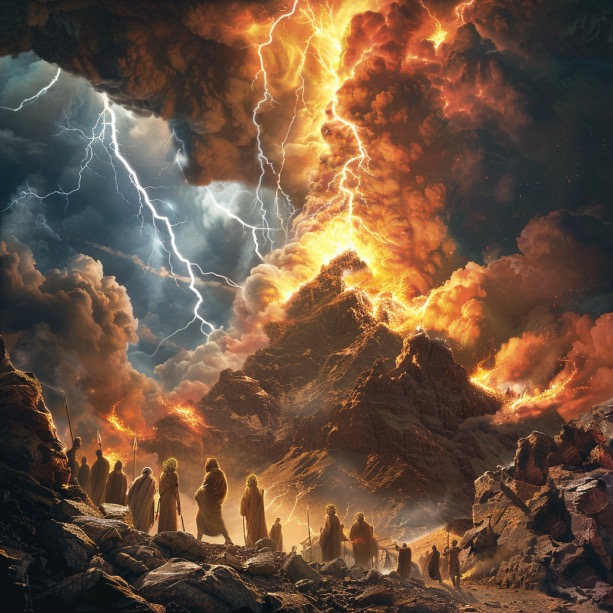
The God of Israel didn’t rise to power—He already reigned. Without contest or rival, YHWH descended on Mount Sinai in fire and thunder to give Israel His Torah. This wasn’t a myth. This was covenant. Israel didn’t win the right to receive it; they weren’t chosen because of their royal lineage or elite class. In Exodus 19:5–6, God calls them a kingdom of priests and a holy nation. The giving of the law wasn’t just legislation—it was an act of divine love, and a declaration of identity. They weren’t just subjects; they were partners in a sacred mission.
Centuries later, this moment was echoed again by the NT authors.
In Acts 2, the disciples were gathered in Jerusalem for Shavuot (Pentecost)—the feast commemorating the giving of the law. But on this day, Luke expresses that God was going further than tablets of stone–It was time for the new covenant to take the world by storm by the Holy Spirit, and the placement of the law on the hearts of men (cf. Jer 31:31-34). Fire descended as at Sinai, but not on a mountain with barriers keeping the people from approaching the glory of YHWH, but upon the people who were followers of Jesus. Luke portrays an interesting event that he calls γλῶσσαι ὡσεὶ πυρός or “tongues as of fire” that come as the wind and rest on the apostles. They spoke in every language, declaring the mighty works of God–interestingly, Luke also intentionally points out a geographical list of places that pilgrims journeyed from.
5 Now there were dwelling in Jerusalem Jews, devout men from every nation under heaven. 6 And at this sound the multitude came together, and they were bewildered, because each one was hearing them speak in his own language. 7 And they were amazed and astonished, saying, “Are not all these who are speaking Galileans? 8 And how is it that we hear, each of us in his own native language? 9 Parthians and Medes and Elamites and residents of Mesopotamia, Judea and Cappadocia, Pontus and Asia, 10 Phrygia and Pamphylia, Egypt and the parts of Libya belonging to Cyrene, and visitors from Rome, 11 both Jews and proselytes, Cretans and Arabians–we hear them telling in our own tongues the mighty works of God.” [Act 2:5-11 ESV]

This was not random.
Luke is deliberately drawing a parallel. There is emphasis in this fascinating picture of redemption. Luke is repurposing multiple motifs from the Hebrew Bible by highlighting the geographical regions. First, he is reversing the notion of dispersed Jews from all the nations–in Luke mind, through belief in Jesus and the giving of the Holy Spirit, the diaspora has the chance to return to Jerusalem and take back the spirit of God with them wherever they go, placing them in a solidified covenantal position that can never be exiled.
27 And the LORD will scatter you among the peoples, and you will be left few in number among the nations where the LORD will drive you. 28 And there you will serve gods of wood and stone, the work of human hands, that neither see, nor hear, nor eat, nor smell. 29 But from there you will seek the LORD your God and you will find him, if you search after him with all your heart and with all your soul. 30 When you are in tribulation, and all these things come upon you in the latter days, you will return to the LORD your God and obey his voice. 31 For the LORD your God is a merciful God. He will not leave you or destroy you or forget the covenant with your fathers that he swore to them. [Deu 4:27-31 ESV]
1 “And when all these things come upon you, the blessing and the curse, which I have set before you, and you call them to mind among all the nations where the LORD your God has driven you, 2 and return to the LORD your God, you and your children, and obey his voice in all that I command you today, with all your heart and with all your soul, 3 then the LORD your God will restore your fortunes and have mercy on you, and he will gather you again from all the peoples where the LORD your God has scattered you. 4 If your outcasts are in the uttermost parts of heaven, from there the LORD your God will gather you, and from there he will take you. 5 And the LORD your God will bring you into the land that your fathers possessed, that you may possess it. And he will make you more prosperous and numerous than your fathers. 6 And the LORD your God will circumcise your heart and the heart of your offspring, so that you will love the LORD your God with all your heart and with all your soul, that you may live. [Deu 30:1-6 ESV]
Just as God had once written His law on stone, now He writes it on human hearts (cf. Jer. 31:33). Just as Israel was called to be a kingdom of priests, now the believers are anointed and empowered to carry that covenant to the nations. Shavuot becomes the declaration of a restored covenant, as fulfilled, internalized, and empowered through Christ. The giving of the Spirit at Pentecost is the fulfillment of the Sinai event: not the abolishment of Torah, but as its transformation into living law—carried out by redeemed people, made holy through Jesus and his spirit and are now bearers of divine identity. Luke even reverses the tragic 3,000 Israelites who were slain for their idolatry with the golden calf, turning the number of 3,000 into a redemptive number of souls being added to the kingdom (cf. Acts 2:24, Ex 32:28).
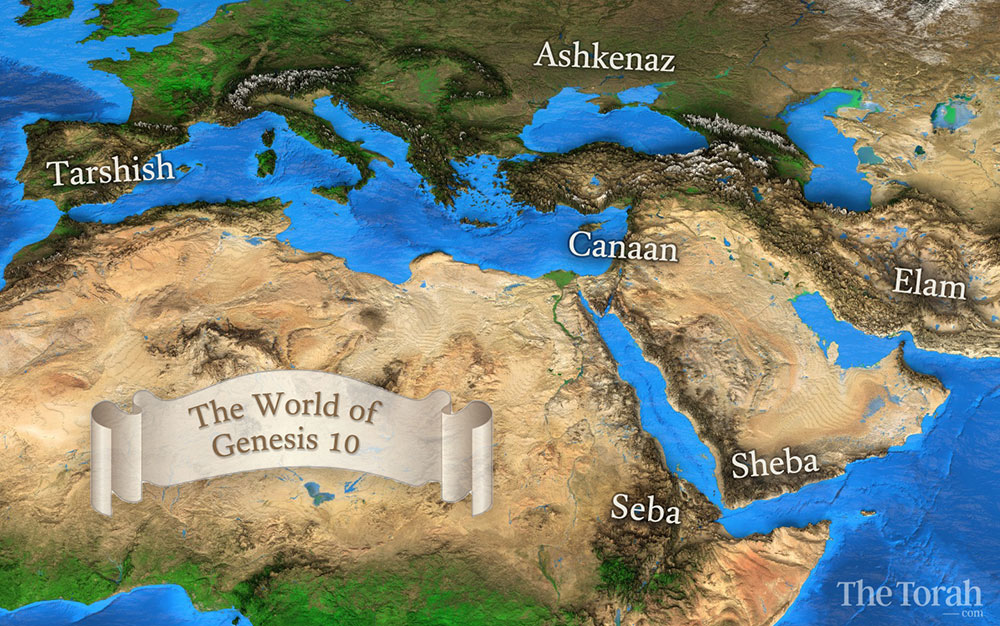
Second, Luke repurposes the narrative of dispersement for all mankind. In his mind, this is a picture of redemption, not just for exiled Israel, but also for the nations who were once dispersed long ago for their disobedience and rebellion. The map he provides us also correlates with the traditional table of the 70 nations in Genesis 10, that are all present in the Tower of Babel narrative, but are divided with tongues because of their sin (cf Gen 11:7-9).
As we can see, for the early Jesus movement, the festival of pentecost was not only the wheat harvest and dedication of the first fruits of the crops by waiving of the bread– but it was a unique picture of The God who redeems. The God who writes His Word on the hearts of his people as He promised. In Luke’s hands, Pentecost is not merely the birth of the church, but the climax of a long story: exile reversed, covenant renewed, Sinai fulfilled, and Babel undone. What empires once claimed through propaganda and kingship, God has now given freely through His Spirit to ordinary men and women. The same God who thundered from Sinai now writes His word on human hearts, transforming His people into a living temple and sending them out as bearers of His presence to the nations. In this way, Luke shows that the redemption promised in the Torah and Prophets has arrived—not in stone tablets or imperial law codes, but in the fire of the Spirit and the covenant of love that can never be exiled.
References
Richardson, M. E. J. Hammurabi’s Laws: Text, Translation and Glossary. London: T&T Clark, 2004.
Jiménez, Enrique. “Marduk and the Battle with the Sea: On the Dating of Enumah Elish.” In Enuma Elish: The Babylonian Epic of Creation, edited by Johannes Haubold, Sophus Helle, Enrique Jiménez, and Selena Wisnom, London: Bloomsbury Academic, 2024
John Day, “The Table of Nations: The Geography of the World in Genesis 10” TheTorah.com (2022). https://thetorah.com/article/the-table-of-nations-the-geography-of-the-world-in-genesis-10
Mark. 2020. The Nations of Pentecost (updated). VisualUnit.
Crossway. The Holy Bible: English Standard Version. Wheaton, IL: Crossway Bibles, 2001.
 Ancient Bible World
Leave a comment