What does it mean to atone for one’s misdoings? How does one restore cosmic and social order after crossing into a state of impurity or disruption? For the ancient Israelites this was completed in a prescriptive annual rite referred to as Yom Kippur, or the Day of Atonement, instituted in Leviticus 16. It stands at the ritual peak of the Pentateuch and the cultic calendar. On this day, detailed rituals were prescribed to purify the tabernacle and its articles, even the ark of the covenant itself underwent blood manipulation so that it might be cleansed from impurity. But why were such precise rites necessary? What do they tell us when set against the backdrop of the ancient Near East? And how did their meaning continue to echo in later Judaism and Christianity?
- Ascending the Cosmic Mountain
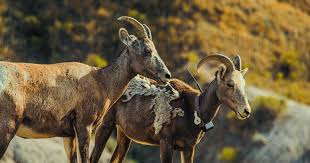
In the ancient Near East, mountains were the meeting place of heaven and earth. From Anatolia to Mesopotamia to Canaan, the gods were imagined as dwelling on cosmic mountains, enthroned where order was established and fertility secured. To ascend a mountain, or to build its man-made counterpart in a temple or ziggurat, was to draw near to the divine realm. Kings and priests performed this ascent as representatives of their people. In Ugarit, Baal was enthroned on Mount Zaphon, his palace symbolizing his victory over chaos and his reign as storm god. Festivals reenacted this drama, joining king and god in their shared work of securing cosmic order. Baal was celebrated as “Rider of the Clouds,” master of thunder and lightning; imagery the Hebrew Bible later redirects to YHWH, Israel’s God, who is proclaimed as the true rider upon the storm. Mount Zion becomes the biblical counterpoint to Mount Zaphon, the dwelling place of the great king (Pardee 2002).
The Hittites went further, deifying mountains themselves. Mountains received offerings, were decorated with sun and moon symbols, and joined seasonal festivals. For them, the mountain was not only the dwelling place of gods but divine in its own right (Cammarosano 2018). Mesopotamian religion transformed the mountain into architecture.
Ziggurats, used in Sumer, Babylon, and Assyria, were massive stepped towers, functioned as artificial mountains, crowned with temples where rituals bridged heaven and earth. The Great Sumerian Ziggurat of Ur exemplifies this: its very design was a statement that ascent brought human beings closer to the divine.
The biblical story reshapes this imagery. Noah’s ark comes to rest on Mount Ararat, Abraham ascends Mount Moriah, Moses meets God on Mount Sinai, and the temple is established on Mount Zion. The tabernacle and temple themselves were structured as cosmic mountains in miniature: the outer court as the base, the Holy Place as the slope, and the Holy of Holies as the summit, where the presence of God dwelled above the ark.
Psalm 24 asks: “Who may ascend the mountain of the LORD? Who may stand in his holy place?”
In Israel’s thought, ascent was not only geography but holiness and mediation.
Yom Kippur brought this theme to its climax. Once a year, the high priest entered the Holy of Holies, the symbolic summit of the cosmic mountain. Carrying incense and blood, he re-enacted humanity’s ascent into God’s presence. For Israel, this was no empty ritual, it was a symbolic return to Eden, the first mountain-garden of divine encounter. By ascending, the high priest restored order, purified the people, and renewed their covenant with YHWH. Israel was not inventing imagery in a vacuum but recasting a widespread ancient pattern: mountains meant meeting God. And in Israel’s vision, YHWH alone reigned from Zion, demanding holiness, humility, and atonement.
- Returning to the Garden of Eden
Another powerful image across the ancient Near East is that of the sacred garden. In Mesopotamian, Ugaritic, and Israelite traditions, gardens represented divine presence, wisdom, and life. They were sources of fertility and order, accessible only to kings and priests. In Mesopotamian thought, gardens and sacred trees were tied to wisdom and cosmic stability. Sumerian and Akkadian texts describe the apkallū, semi-divine sages, act as guardians and intermediaries for the tree of life. Neo-Assyrian palace reliefs show them flanking a stylized tree, holding ritual objects for purification.
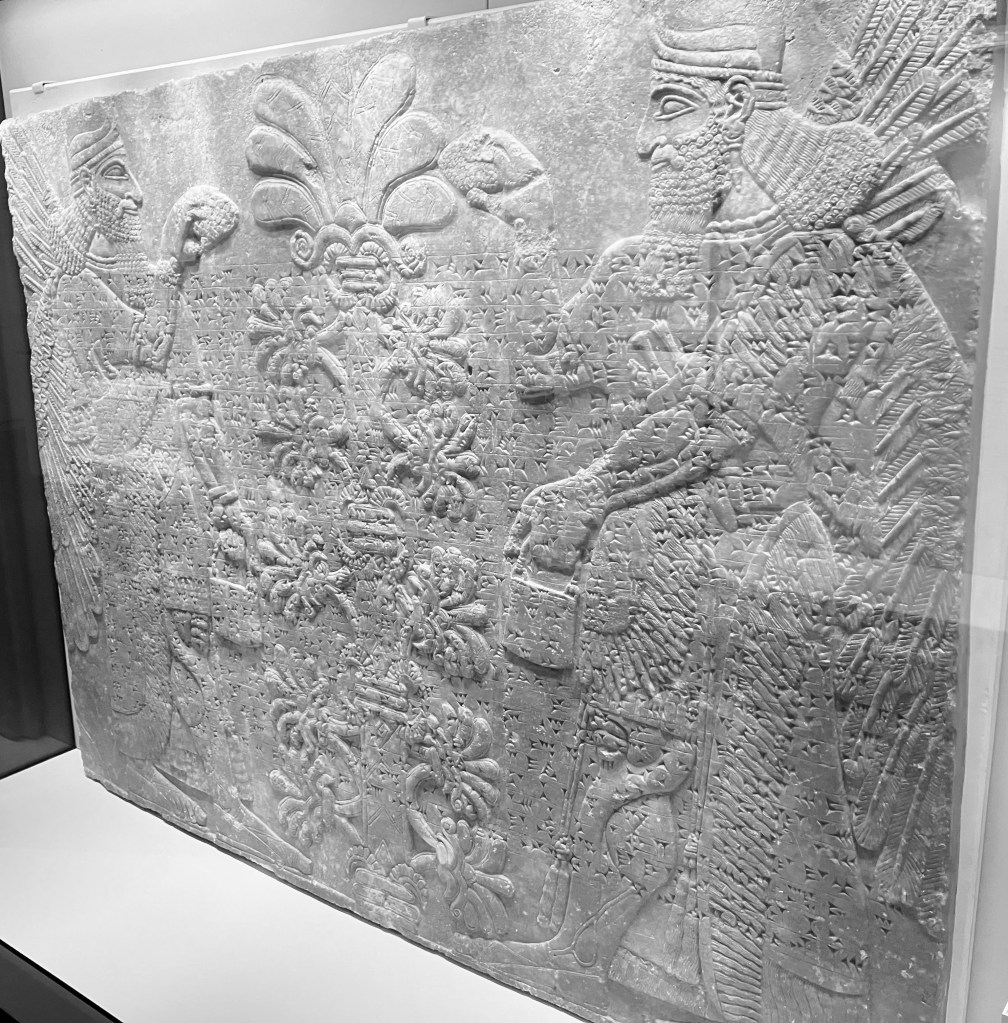
Wall relief from the North-West Palace of King Ashurnasirpal II, Nimrud.
The Epic of Gilgamesh likewise speaks of the hero’s quest for a plant of eternal life hidden in the cosmic waters, a longing to regain divine wisdom and immortality. In Ugaritic texts, the god El’s dwelling is also pictured as a verdant garden on the cosmic mountain, nourished by streams where the divine assembly gathers. One ritual text (KTU 1.41) even describes the king building a shrine for Ilu out of branches, reminiscent of Israel’s sukkah tradition (Pardee 2002).
Biblical texts also preserve this imagery. In Eden, humanity is barred from the tree of life by cherubim (Gen 3:24). The tabernacle veil, embroidered with cherubim (Ex 26:31), repeats the motif of restricted access. The menorah, shaped like an almond tree (Ex 25:31–40), reflects the tree of life, and Solomon’s temple elaborates the theme with abundant garden imagery (1 Kgs 6:29). As Michael Morales argues, the sanctuary was a cosmic map of Eden: the outer court symbolized the world beyond, the Holy Place, the garden itself, and the Holy of Holies the tree of life (Morales 2015).
Therefore, Yom Kippur reenacted this in a sort of climactic ritual drama. When the high priest entered the Holy of Holies, he symbolically re-entered Eden, restoring the harmony lost in Adam’s exile. Sprinkling blood upon the ark and tabernacle did more than cleanse the sanctuary, it undid the primal rupture, bringing Israel once more into God’s presence. The scapegoat, sent into the wilderness, removed impurity so that the sanctuary could be restored to Eden-like purity.
- Cleansing the House of God and Restoring Order
Leviticus 16 begins with a reminder of the deaths of Nadab and Abihu (Lev 16:1; cf. Lev 10). Gabriel Morales has argued that the Day of Atonement rites were instituted in response to that tragedy (Morales 2015:170). Jacob Milgrom explains that the two sons polluted the sanctuary first by their sinful act and then by their corpses (Milgrom 1991). Though no cleansing is described in Leviticus 10, chapter 16 makes clear that God’s dwelling required regular purgation because of this incident. Without it, His presence could not remain among His people. The sacrifices of Yom Kippur included a bull, rams, and most memorably two goats. The first goat was slain, its blood was used for the atonement, or purifying of the sanctuary. The other scapegoat, was symbolically laden with Israel’s sins and sent into the wilderness (Lev 16:7–22).
The Hebrew כפר (kpr) means to cover or purge; Akkadian cognates kapāru and kuppuru describe smearing or wiping in ritual contexts. These offerings, especially the first goat, effectively “scrubbed” the sanctuary clean (CAD vol 8). Other cultures practiced similar rites, relating to cleansing to appease the judgement of the gods. (Milgrom 1991) describes various Hittite and Mesopotamian ceremonies that purified temples, especially certain rites in Babylon’s akitu festival. During this 11-12 day festival, Marduk’s temple was cleansed with blood, fire, incense, and river water from the Tigris and Euphrates. Once this was completed, the image of Marduk was returned to his house in the city of Babylon, so that he could judge the king and his city. The king and high priest engaged in a unique humbling ritual where the king was slapped and his reaction revealed his legitimacy as ruler–the tablets of destiny were read, and Babylon was secure for another year (Sommers 2000).
The Hebrew כפר (kpr) means to cover or purge; Akkadian cognates kapāru and kuppuru describe smearing or wiping in ritual contexts. These offerings, especially the first goat, effectively “scrubbed” the sanctuary clean (CAD vol 8). Other cultures practiced similar rites, relating to cleansing to appease the judgement of the gods. (Milgrom 1991) describes various Hittite and Mesopotamian ceremonies that purified temples, especially certain rites in Babylon’s akitu festival. During this 11-12 day festival, Marduk’s temple was cleansed with blood, fire, incense, and river water from the Tigris and Euphrates. Once this was completed, the image of Marduk was returned to his house in the city of Babylon, so that he could judge the king and his city. The king and high priest engaged in a unique humbling ritual where the king was slapped and his reaction revealed his legitimacy as ruler–the tablets of destiny were read, and Babylon was secure for another year (Sommers 2000).
The second goat sent out to the wilderness, also has parallel expulsion rituals in the ancient world: animals bearing impurity or curses were sent to the wilderness or underworld, as documented by Milgrom, and further collected by Ayali-Darshan (2020). These ceremonies used various animals such as birds, frogs, and goats–and often involved binding animals, and reciting curses or chants. For the Israelite high priest, this was dangerous work. To enter the Holy of Holies was to approach the divine throne, where any offense meant death. The Day of Atonement ensured that judgment would not fall, and that God’s presence would remain. Yom Kippur was therefore not merely forgiveness but the restoration of cosmic order: impurity was removed, the sanctuary cleansed, and the covenant renewed.
A Final Note: Shifting Gears to Yom Kippur in the Second Temple Period
By the Second Temple period, eschatological hope was intertwined with Yom Kippur and Jubilee because of the holidays connection in (Lev 25) where it announces the Jubilee year. In the fragmented scroll 11QMelchizedek, this authoritative heavenly figure Melchizedek, who acts as God’s agent of deliverance, comes announcing liberty and inaugurating the sabbatical age that comes with the Day of YHWH.
Rick Van De Water shows how this figure functioned as a divine intermediary, blending Isaiah’s year of liberty, and Daniel’s seventy weeks (cf. Is 61:1-2, Dan 9:24-27) into a grand vision of final atonement. In this very interesting non-biblical scroll, Melchizedek proclaims liberty, executes judgment, and brings peace, operating in functions that overlap with YHWH Himself (Van De Water 2006). Thus, it is no surprise that some Jews of this sect, associated this figure with Messianic characteristics.
11Q Melchizedek Col. II 1–17
“In this year of jubilee, you shall return, each one, to his respective property, as is written: This is the manner of effecting the release: every creditor shall release what he lent to his neighbor. He shall not coerce his neighbor or his brother when the release for God has been proclaimed.” Its interpretation for the last days refers to the captives: “To proclaim liberty to the captives.” He will make their rebels prisoners and they will be the inheritance of Melchizedek, who will bring them back. He will proclaim liberty to free them from the debt of all their iniquities. This occurs in the first week of the Jubilee following the nine jubilees. The Day of Atonement marks the end of the tenth Jubilee, when atonement is made for all the sons of God and the men of the lot of Melchizedek. On the heights, he declares their favor according to their lots, for it is the year of grace for Melchizedek, who will exalt the holy ones of God through judgment, as written in the songs of David: “Elohim will stand up in the assembly of God; in the midst of the gods he judges.” He will judge the peoples from on high, asking, “How long will you judge unjustly and show partiality to the wicked? Selah.” This concerns Belial and the spirits of his lot, all rebels turning aside from God’s commandments. Melchizedek executes God’s vengeance on this day, freeing them from the hands of Belial and his cohorts. To his aid come all the gods of justice; he prevails over all the sons of God and presides over this assembly. This is the day of peace foretold by Isaiah: “How beautiful upon the mountains are the feet of the messenger who announces peace, of the messenger of good who announces salvation, saying to Zion: ‘Your God reigns.’” The mountains are interpreted as the prophets (Martínez 1996).
It is in this backdrop, that the NT adopts this Messianic framework, applying it to Jesus. Luke presents Jesus reading Isaiah 61:1 in the synagogue, declaring its fulfillment (Lk 4:17–21). The Jubilee, already linked to Yom Kippur in Leviticus 25, provided the prophetic context.
“And the scroll of the prophet Isaiah was given to him. He unrolled the scroll and found the place where it was written, ‘The Spirit of the Lord is upon me, because he has anointed me to proclaim good news to the poor. He has sent me to proclaim liberty to the captives and recovery of sight to the blind, to set at liberty those who are oppressed, to proclaim the year of the Lord’s favor.’ And he rolled up the scroll, gave it back to the attendant, and sat down. And the eyes of all in the synagogue were fixed on him. And he began to say to them, ‘Today this Scripture has been fulfilled in your hearing’” (Lk 4:17–21, cf. Is 61:1).
The writer of Hebrews presents Jesus as the High Priest who enters the heavenly sanctuary, mediating a new covenant and cleansing sin once for all referring to Jesus as one like Melchizedek (Heb ch. 7, 8, & 9:11–28; 10). In the theology of Hebrews, the blood of goats may have purified the tabernacle; the blood of Christ was what purged human hearts. Later Jewish thought retained the imagery of heavenly ledgers. The Babylonian Talmud describes three books opened at the Day of Trumpets, with the final judgement at Yom Kippur, determining the fate of the righteous, wicked, and those in between. This concept builds on both biblical and Second Temple imagery of divine books: (e.g.,Moses’plead in Exodus 32, the psalmist in Psalm 69, the prophet Daniel in Daniel 7, and 1 Enoch’s heavenly tablets).
“The Gemara goes back to discuss the Day of Judgment. Rabbi Kruspedai said that Rabbi Yoḥanan said: Three books are opened on Rosh HaShana before the Holy One, Blessed be He: One of wholly wicked people, and one of wholly righteous people, and one of middling people whose good and bad deeds are equally balanced. Wholly righteouspeople are immediately written and sealed for life; wholly wicked people are immediately written and sealed for death; and middling people are left with their judgment suspended from Rosh HaShana until Yom Kippur, their fate remaining undecided. If they merit, through the good deeds and mitzvot that they perform during this period, they are written for life; if they do not so merit, they are written for death” (Rosh Hashanah 16b:12)
The New Testament also expresses a similar theme, but with the book of life being placed under the authority of the Lamb (Rev 3:5, 20:12–15,21:27), where names inscribed signify eternal destiny. Thus it may be said then, that despite thousands of years of timespan, Yom Kippur’s imagery is boundless. From the high priest’s ascent into God’s presence, to Qumran’s Melchizedek, to the New Testament vision of Christ as eternal High Priest, to rabbinic reflection on heavenly books. At its core, the Day of Atonement remains what it was in Leviticus 16 prescribed it as–a sacred drama of ascent, cleansing, Judgement and restoration, ensuring that God’s true people might continue to dwell with Him in holiness and peace.
Bibliography
Ayali-Darshan, Noga. “The Scapegoat Ritual and Its Ancient Near Eastern Parallels.” TheTorah.com. 2020. https://thetorah.com/article/the-scapegoat-ritual-and-its-ancient-near-eastern-parallels.
Chicago Assyrian Dictionary. The Assyrian Dictionary of the Oriental Institute of the University of Chicago. Vol. 8, K. 21 vols. Chicago: The Oriental Institute of the University of Chicago, 1956–2010.
Cammarosano, Michele. Hittite Local Cults. Studies in Ancient Near Eastern Records 27. Berlin: De Gruyter, 2020.
García Martínez, Florentino. The Dead Sea Scrolls Translated: The Qumran Texts in English. 2nd ed. Leiden: E.J. Brill; Grand Rapids, MI: Wm. B. Eerdmans, 1996.
Milgrom, Jacob. Leviticus 11–16: A New Translation with Introduction and Commentary. The Anchor Yale Bible. New Haven and London: Yale University Press, 1991.
Morales, Michael. Who Shall Ascend the Mountain of the LORD? A Biblical Theology of the Book of Leviticus. New Studies in Biblical Theology 37. Downers Grove, IL: InterVarsity Press, 2015.
Pardee, Dennis, and Theodore J. Lewis. Ritual and Cult at Ugarit. Writings from the Ancient World 10. Atlanta: Society of Biblical Literature, 2002.
Pulse, Jeffrey. “Ascending to God: The Cosmology of Worship in the OT.” Concordia Theological Quarterly. Fort Wayne, IN: Concordia Theological Seminary, 2015.
Sommer, Benjamin D. “The Babylonian Akitu Festival: Rectifying the King or Renewing the Cosmos.” Journal of the Ancient Near Eastern Society 27 (2000): 81–95.
Van de Water, Rick. “Michael or YHWH? Toward Identifying Melchizedek in 11Q13.” Journal for the Study of the Pseudepigrapha 16, no. 1 (2006).
Sefaria. The William Davidson Talmud: Rosh Hashanah. Translated by Rabbi Adin Even-Israel Steinsaltz. Sefaria, 2017. https://www.sefaria.org/Rosh_Hashanah.
 Ancient Bible World
Leave a comment