In the Books of the records of the Kings, the situation in the northern kingdom of Israel had fallen into grave disarray. The dynasty of Ahab, along with his Phoenician wife Jezebel, had taken complete control of the region and institutionalized Baal worship, effectively outlawing the worship of YHWH (1 Kgs 16:30–33; 18:4, 19). Under their rule, prophets of YHWH were systematically executed, leaving Elijah as one of the few remaining prophets in the land (1 Kgs 18:22; 19:10). In response, YHWH revealed to Elijah that He would raise up new leaders to bring judgment on the house of Ahab and purge Israel of its corruption. Elijah was commanded to anoint Hazael as king over Aram (Syria), Jehu as king over Israel, and Elisha as prophet in his own place (1 Kgs 19:15–17). These anointed figures would, in different ways, serve as agents of divine judgment. In the time of Elisha, these prophecies began to unfold. Hazael of Aram assassinated his master, King Ben-Hadad II, and seized the throne, subsequently launching campaigns against Israel (2 Kgs 8:7–15, 28–29). Meanwhile, King Joram (Jehoram) son of Ahab ruled Israel, and King Ahaziah ruled Judah; the two were allied at this time (2 Kgs 8:28–29).
At YHWH’s command through Elisha, one of the prophet’s disciples anointed Jehu as king over Israel at Ramoth-gilead (2 Kgs 9:1–10). Immediately, Jehu began to carry out divine retribution against the house of Ahab. He first pursued and mortally killed King Joram of Israel with an arrow through the heart, and then struck down King Ahaziah of Judah as he fled (2 Kgs 9:21–28). Jehu then advanced to Jezreel against queen Jezebel, queen of the land and promoter of Baal–she met her violent end when she was thrown from a window and trampled underfoot, her carcass eaten by the dogs before she could be buried (2 Kgs 9:30–37). Continuing his campaign, Jehu orchestrated a trap to gather all the prophets and worshippers of Baal under one roof, under the pretense of offering a great sacrifice to Baal. This was only so that he could slaughter them and destroy the temple of Baal completely (2 Kgs 10:18–28). Finally, Jehu executed all remaining descendants of Ahab, fulfilling YHWH’s word through Elijah that none of Ahab’s line would survive (2 Kgs 10:1–11, 17). Through these events, the house of Ahab was eradicated, Baal worship was purged from Israel, and the divine judgment declared through the prophets manifested. Yet not long after the new Jehu king was used to successfully enact the will of YHWH, the aftermath of his coup was to return to the sins of Jeroboam and worship the golden calves at Dan (2 Kgs 10:31). Thus, after much success in the region, the king of Syria, Hazael, who was anointed around the same time as Jehu was used to come against Israel–the author of kings portrays it as a direct result of Jehu’s sin.
31 But Jehu was not careful to walk in the law of the LORD, the God of Israel, with all his heart. He did not turn from the sins of Jeroboam, which he made Israel to sin. 32 In those days the LORD began to cut off parts of Israel. Hazael defeated them throughout the territory of Israel: [2Ki 10:31-32]
As History would have it, this would not be the only problem Jehu would face during his 28-year reign. While the bible makes no mention of it, the king of Assyria, Shalmaneser III would come into direct contact with the king of Israel during his campaigns to the west. We have this attested in multiple Assyrian inscriptions, most notably the black Obelisk of Shalmaneser III.
Assyrian kings were masters of royal ideology, weaving their authority into every campaign and monument. From the Middle Assyrian period through the height of the Neo-Assyrian Empire, rulers believed they were carrying out the command of their chief god, Ashur: “Expand your land!” (Maul 2017). Conquest was not simply politics; it was a divine mandate, and the expansion of territory became the measure of a king’s success. For Neo-Assyrian rulers like Shalmaneser III who ruled from 858-824 BCE, this belief drove both his ambitious building projects and his relentless military campaigns. He would continue in the vigorous military polices of his father Ashurnasirpal II, against Urartu in the north, and the Aramean kingdoms in the west (Frahm 2017).
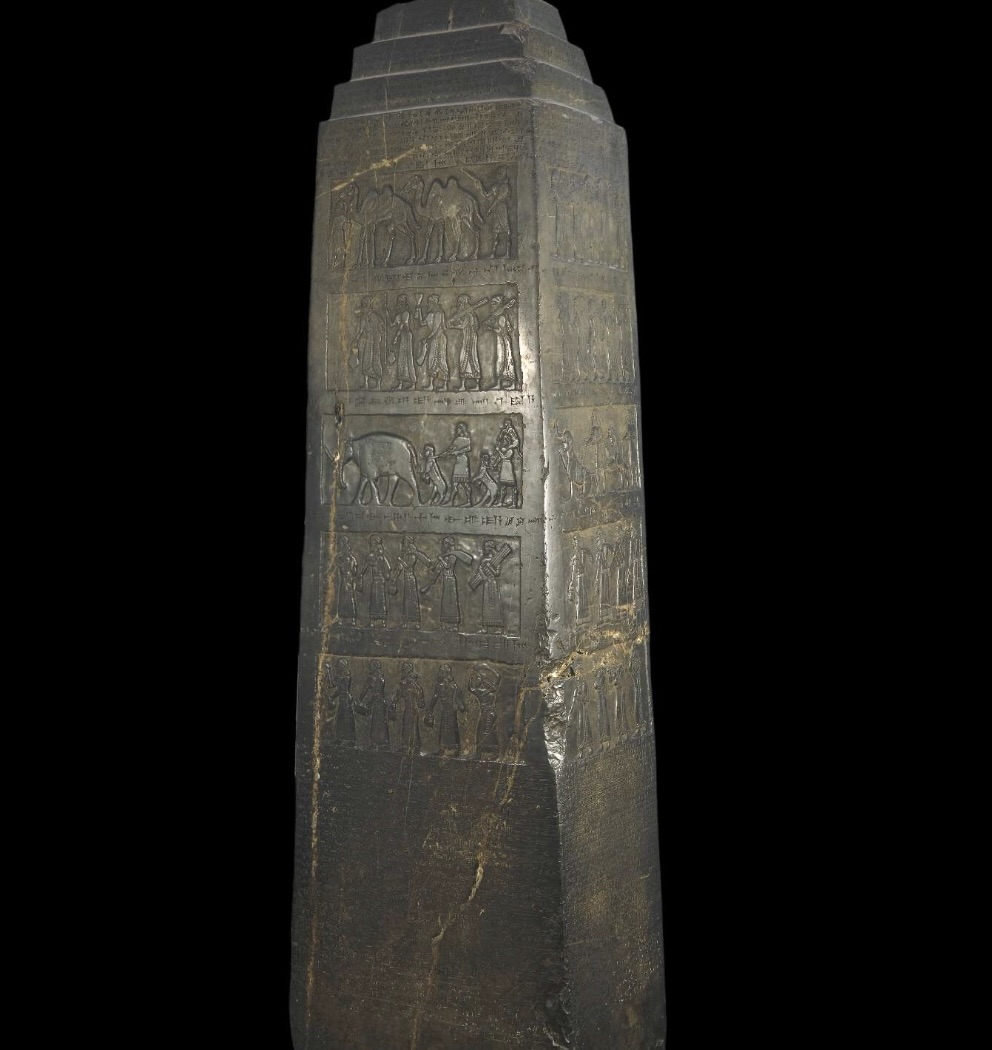
In 1846 The Black Obelisk of Shalmaneser III was discovered by Austen Henry Layard in the Northwestern corner of an open plaza located south of the Central building built by Assurnasirpal II, at Calah or Tel Nimrud, one of the few capital cities of Neo Assyrian Kings. If was found east of the “Centre Bulls” a pair of colossal, winged bulls attributed to Shalmaneser III. Layard recorded that the obelisk was found over fifty feet north of the Centre Bulls, placing it within this open area between the two structures (Oates 2024). The upper portion of the obelisk is shaped like a stepped tower ziggurat Akkadian ziqquratu. It consists of 190 lines inscribed around the tower, and beneath the five bands of reliefs on the body of the obelisk. The inscriptions are mostly numbered according to the years of the king’s reign, referred to as palû in Akkadian enabling us to securely date the era. It preserves a summary of the military campaigns of Shalmaneser III up until year 826 which is contemporary with our Israelite kings Ahab and Jehu. In his summary of the inscription, Mordecai Cogan expands on Shalmaneser’s campaigns to the west to places like Damascus, Israel, and others who were included in the anti-Assyrian coalition (Cogan 2008).
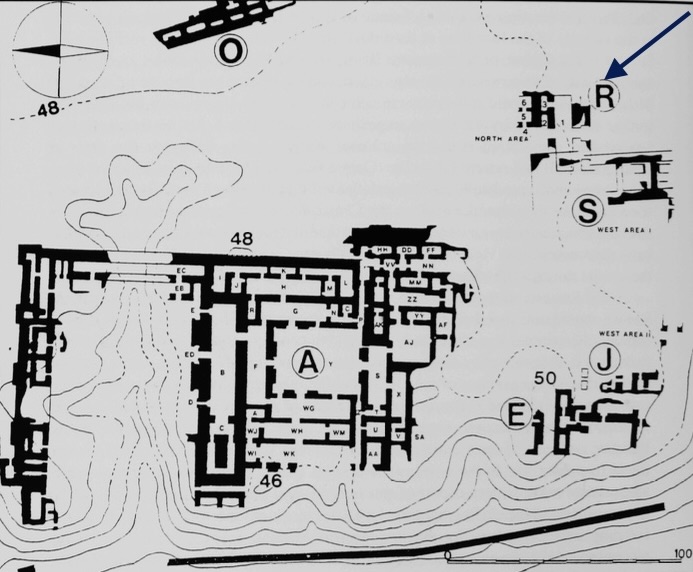
R= Center Building of Assurnasirpal II Where the Obelisk was found (Oates 2024).
While the bible makes no mention of Jehu’s submission to Shalmaneser III, this is the second mention of an Israelite king in Assyrian inscriptions; the first is Ahab written about in the Kurkh Monolith inscription during Shalmaneser’s previous campaign at the battle of Qarqar. In 853, Assyrian troops faced the armies of a massive coalition of western states in the vicinity of the city of Qarqar on the Orontes river. The coalition was led by Hadad‐ezer, king of Damascus, and included, among others, king Irḫuleni of Hamath, king Ahab of Israel, and a certain Gindibu, a leader of the Arabs who supplied the allied forces with 1000 camels. The references to the latter two in the inscription on Shalmaneser’s “Kurkh monolith” constitute the earliest available attestations of named Israelite and Arab rulers. Even though Shalmaneser claims that the battle of Qarqar ended with a great victory for himself, he probably achieved a stalemate at best. The Assyrians did not make any substantial political or territorial gains (Frahm 2017).
It would be during During the 840s and 830s, Shalmaneser undertook a number of additional campaigns in Syria, with armies that included, at one point, no fewer than 120,000 soldiers according to royal inscriptions. The results of these attacks were initially fairly modest, but, in 841, after the death of Hadad‐ezer of Damascus, several western rulers, among them Irḫuleni of Hamath and Jehu, the new king of Israel, sent tribute to Assyria. Jehu’s submission is depicted on Shalmaneser’s “Black Obelisk,” which also reveals that an unnamed king of Egypt brought the Assyrian king presents, among them camels, elephants, and monkeys. On three occasions between 841 and 837, Assyrian troops laid siege on Damascus, now ruled by a new king, Hazael, but did not manage to conquer the city (Frahm 2017).
“I received the tribute of Jehu, son of Omri: silver, gold, a gold bowl, a gold vase, gold goblets, gold buckets, tin, a royal scepter and javelins.” (Cogan 2008).

ia-u-a mārum ana Ḫu-um-ri-i
Iaua mār ana Ḫumri
“Jehu son of Omri”
Jehu is recorded by the Assyrian scribe as son of Omri, even though the Bible records him as son of Jehosephat and son of Nimshi–both father and grandfather listed here (cf. 2 Kgs 9:2, 20). Cogan noted how it is unusual to see three generations listed as they are in these passages but comments it was likely because of his grandfather’s fame or maybe it was the name of a tribe he was part of. Whatever the case, we know that Jehu was not a literal son of Omri the great Israelite king who launched a successful dynasty in the eighth century. This inscription was not due to lack of knowledge on the part of the Assyrians regarding Israel’s political and monarchal affairs, rather it shows a scribal tradition that recognized the rule and dynasty of Omri as successful and was a common practice for other kings in other nations as well e.g., Arpad is the house of Agusi and Damascus was the house of Hazael. Israel was the house of Omri–this label lasted long after Jehu was gone from the throne (Cogan 2008). The Israelite king is seen bowing down in full submission to his Suzerain Shalmaneser while paying him tribute of articles of gold and silver. Perhaps a consequence of his deterring from the worship of YHWH to follow in the footsteps of Jeroboam as depicted in the record of 2 Kings 10. Jehu’s reign serves as a reminder that political zeal and temporary success cannot substitute for covenantal faithfulness. In seeking to secure his throne through human alliances, Jehu ultimately forfeited the divine protection that had first established his rule.
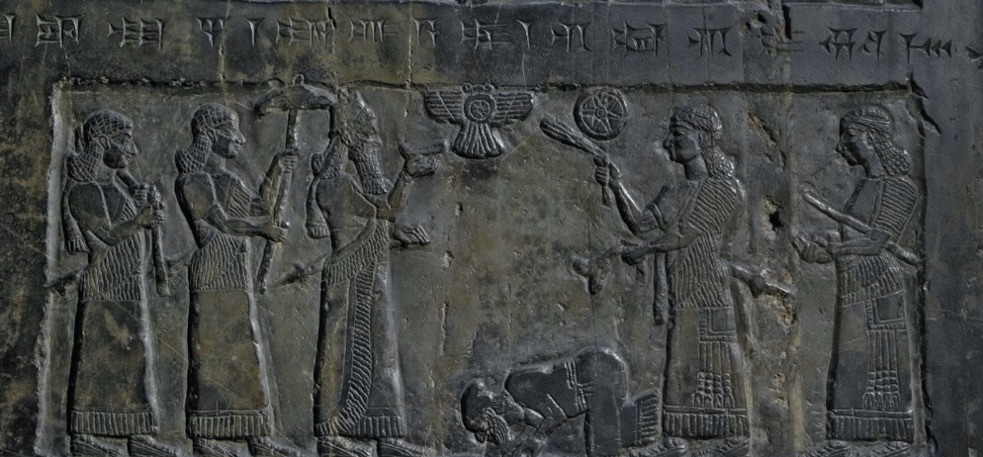
Jehu depicted bowing and paying tribute to King Shalmaneser III

Shalmaneser III’s Aramean Campaign 841 BCE (Cogan 2008).
Bibliography
Frahm, Eckart & Maul, Stefan. “Assyria and Its Army.” In A Companion to Assyria, edited by Eckart Frahm, 171–173. Hoboken, NJ: Wiley Blackwell, 2017.
Cogan, Mordechai. The Raging Torrent: Historical Inscriptions from Assyria and Babylonia Relating to Ancient Israel. Jerusalem: Carta, 2008
Russell, John Malcolm. Writing on the Wall: The Architectural Context of Late Assyrian Palace Inscriptions. Winona Lake, IN: Eisenbrauns, 1999
Oates, Joan. Nimrud: An Assyrian Imperial City Revealed. Archive of Mesopotamian Archaeological Reports (AMAR) 423. 2024
Photos of the Black Obelisk taken from: The Black Obelisk of Shalmaneser III. Limestone, ca. 825 BCE. From Nimrud (ancient Kalhu). British Museum, London. ME 118885. British Museum Collection Online. https://www.britishmuseum.org/collection/object/W_1848-1104-1?selectedImageId=72218001. Accessed October 7, 2025
 Ancient Bible World
Leave a comment