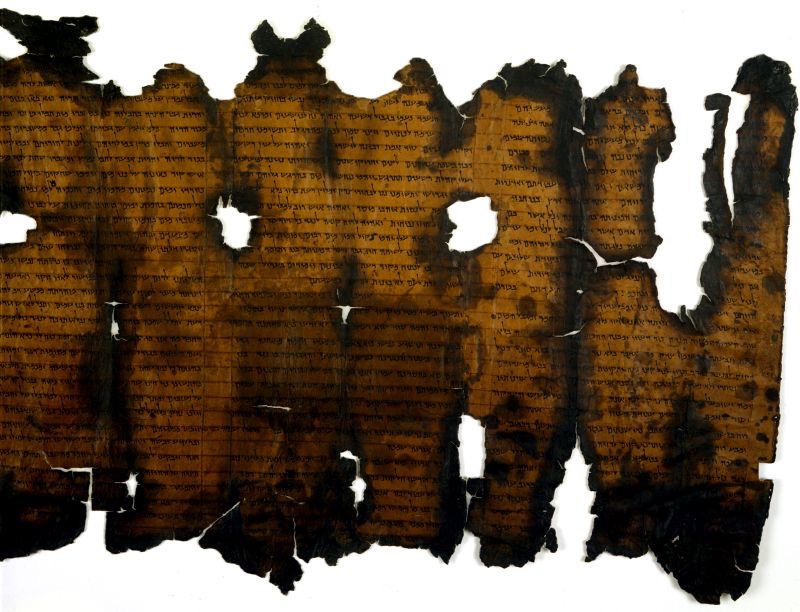
1QHadayota Photo The Israel Museum, Jerusalem, by David Harris From the Israel Museum publications 1998
Introduction
In the spring of 1947, the same year that the nation of Israel would start to become a reality for the first time in over 2,000 years–a young Arab shepherd climbed into a cave in the Judean Desert and stumbled upon the first of the Dead Sea Scrolls. Although the Scrolls are no longer considered the “recent discovery” they were once called, their significance has continued to grow, and they are still widely regarded as one of the greatest archaeological discoveries in all of history. The focus of this brief study will be on what is called The Hymns Scroll, or “Thanksgiving Scroll” in Hebrew called, Hodayot הודיות. It is a non-Biblical scroll that is typically placed in the category of sectarian Liturgy and Hyms. It’s initial components were found in Cave 1 at the archaeological site of Qumran, in the northern region of the Dead Sea, and were first published by E. L. Sukenik in 1954-55 in The Dead Sea Scrolls of the Hebrew University of Jerusalem. More fragments would later be discovered in Cave 4 and the scroll would be fully published in DJD Volume 40. The primary manuscripts include 1QH, 1Q35, (cf. 1Q36, 37-40) and 4Q427–432. The numbering system refers to their cave, their site of discovery eg., 1QH or 1Q35 = Cave 1, Qumran, Hodayot or Fragement 35. While they are not biblical scrolls, the poems in this collection strongly resemble the Biblical Psalms and consist mostly of hymns of thanksgiving and individual prayer. Some scholars have proposed they were intended for communal worship, but more recently there has been argumentation towards them being litergey for a high ranking leadership figure of the community referred to as the Maśkîl משכיל who is mentioned in the Scroll (Newsom 2021; 8-13). The Scroll articulates a range of spiritual doctrines, to include emphasis on YHWH’s predestination and deliverance, forming two of the dominant themes throughout (Vermes 2011, 49-250).
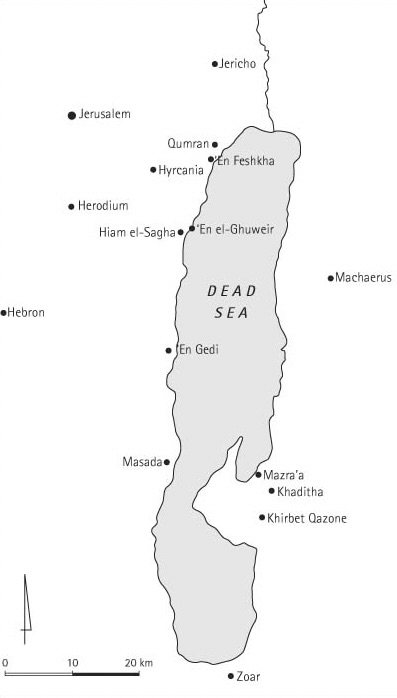
Qumran and Surrounding area (map by Rachel Hachlili) from Lim & Collins 2010 Map 1.
“I Give Thanks” The Nature of the Hodayot
The writings of the Thanksgiving scroll are sharply unique compared to the rest of the DSS in a variety of ways–while they are conisedered non biblical in content because they are not identified as copies of texts found in the canon of the HB, they are certainly biblical in their nature and topoi throughout the text. The language of the scroll reminds us of many verses and sections in the Psalms; several columns of passages begin in first person with an individual conveying his constant thanksgiving to YHWH. The opening lines such as “I give thanks to you Lord” and “Blessed are you Lord.”
1QHa (1QHodayota)
Col IV Lines 17 & 26
17 “I give you thanks for the spirits which you placed in me. I want to find a reply on my tongue to recount your acts of justice and patience”
26 “I give you thanks because you have spread you Holy Spirit upon your servant ant… his heart” (Martinez 1999, 148-49).
These types of admirations are found throughout many fragments of the scroll as a repeated theme for the author–calling to mind similar styles in the psamls such as in Ps 9:2a opening with “I will give thanks to the Lord with my whole heart” אודה יהוה בכל לבי. One difference between the scribe of the Hodayot and the Pslamist is the replacement of the tetragrammaton in the texts with אדוני in many cases. The term אלי is also found in the text, written in Paleo Hebrew script. Lichtenberger notes;
“Within the Scrolls corpus, other divine names were also written in paleo-Hebrew characters and/or replaced by other designations for God. In some manuscripts only the Tetragrammaton is written in paleo-Hebrew characters (e.g., 11QPsa), in others אל is sometimes written in paleo-Hebrew characters (1QHa 7:38; 9:28; 1Q35 1 5; אלי 1QHa 10:36). In 4Q57 (Isac), not only is the Tetragrammaton, together with its prepositions and conjunctions, written in paleo-Hebrew script, but also אלוהים, together with its suffixed forms. צבאות occurs here in paleo-Hebrew and Aramaic square script, as well as אדוני ;אל never appears in 4Q57. Here, in one and the same manuscript, occur various forms attested elsewhere in diverse contexts. Apart from this evidence, it must be recognized that in the majority of manuscripts from the Dead Sea, divine names are written in the same script as the surrounding text” (Litchtenberger 2018, 141).

1QHa (1QHodayota)
Col XIII Line 20
20 “I give you thanks. Blessed are you, Lord, because you did not desert the orphan nor have you slighted the wretch. For your might is unfathomable and your glory is 21 measureless…”
As we can see, the focus of grattitue is what gave the scroll its name the Thanksgiving Scroll. While it shares strong parallels with the Psalms, it also carries unique features of its own that derive from this fasciniating community in the desert, their scribes, and their ideology. The distinctiveness is not merely literary or stylistic; it is also rooted in a worldview that attributes every human impulse, insight, and destiny to divine determination. This theological orientation naturally leads into the scroll’s pronounced doctrine of predestination.
Predetermined Destiny in Hodayot
In addition to the Thankskgiving Scroll having its own unique language and style, another element that attracts much attention is the author’s pecular interest in the predetermninism of YHWH and His soveringty, in contrast to the agency and responsiblity of mankind. Some have commented that in the scroll of Hodayot, there appears to be inconsistancies. On the on hand its ideology reflects complete denial of man’s ability to choose his path for himself because of the soveignty of God, and on the other, it emphasizes mans requirement to choose to follow the precepts of YHWH, and the convenant community. See for example the author’s theological expressions of soverinty and predetermism while at the same time, speaking about choice and personal responsibity. The tension in the texs is undeniable:
Col VII Lines 14-25
14 I have imposed on myself not to turn aside from all that you have commanded. I join the Many … so as not.. 15 to desert all your precepts. But I, I know, thanks to your intellect, that … is not by the hand of flesh, and that a man can not choose 16 his way, nor can a human being establish his steps. I know that the impulse of every spirit is in your hand, and all its task 17 you have established even before creating him. How can anyone change your words? You, you alone, have created 18 the just man, and from the womb you determined him for the period of approval, to keep your covenant, and to walk on all (your paths), and to … on him 19 with the abundance of your compassion, to open all the narrowness of his soul to eternal salvation and endless peace, without want. And you have raised 20 his glory above flesh. Blank But the wicked you have created for [the time] of your wrath, from the womb you have predestined them for the day of slaughter. 21 For they walk on a path that is not good, they reject your covenant, their soul loathes your … and they take no pleasure in what 22 you command, but choose what you hate. You have established all those who … your … to carry out great judgments against them 23 before the eyes of all your creatures, so they will be a sign and a poor tent for eternal generations, so that all will know your glory and your great might. 24 What, then, is flesh, to understand your mysteries? How can dust direct its steps? Blank 25 You have fashioned the spirit and have organised its task before the centuries. From you comes the path of every living being.
Notice how the author denotes imposition on himself, to not turn aside from all YHWH has commanded–yet at the same time, it is not by the hand of the flesh that a man can choose his way nor establish his steps. Similarly in lines like (Col VIII:31-33) the scribe notes that justice and a perfect path does not belong to a son of Adam–but only God can produce good acts in people, it is only by the spirit that God has put in man that he can commit any acts of justice. Any knowledge posessed by a person, especially a member of the community, is attributed only to God’s openeing of his ears. Man is the clay and God is the potter, and everything has been engraved in God’d record beforehand (Col IX:21-25). This certainly calls to mind the verses in the prophets and even later NT discussion of the Apostle Paul (Jer 18:1-6, Is 64:8 cf. Rom ch 8-11).
Carol Newsom argues that the Hodayot are not inconsistant in their views of soteriology and predeterminism, but that they intentionally weave together divine predestination and personal human agency, grounding this tension in a sophisticated interpretation of humans as molded clay, deprived flesh, with a spirit given to them by God alone as seen Genesis, Job, and Ezekiel creating a theology of a self that is shaped by both flesh and the divine spirit (Newsom 2018, 196-209). She further argues that the poet deliberately juxtaposes voluntarist expressions of obedience with strong predestinarian claims to articulate a coherent anthropology drawn from the sectarian reading of Scripture. By weaving together biblical images of humanity as weak “flesh” (Gen 2–3; Job 4) with Ezekiel’s promise of a divinely given spirit (Ezek 36–37), the Hodayot construct a vision of the self whose genuine moral action is entirely dependent on God’s prior determination. In Newsom’s view, this tension is therefore not a flaw but a purposeful theological strategy that reflects the community’s exegetically shaped understanding of how divine sovereignty and human participation coexist.
Hodayot & The Teacher of Righteusness
The final feature to be addressed is the question of the Hodayot’s authorship. While it is near impossibe to know for certain, mid twentieth century scholars traditionally attributed authroship to two categoreis. One category consists of hymns attributed to the Teacher of Righteousness who is known from other scrolls. The core sectarian writings associated with the Teacher of Righteousness include texts preserved in multiple copies as the texts that explicitly mention the Teacher such as the Damascus Document, and the pesharim. However, commentators lke Timothy Lim for example, have argued that through closer literary analysis of more sectarian scrolls, elements of the teacher appear in Rule of the Community, the Thanksgiving Hymns, 4QMMT, the War Scroll, and the Songs of the Sabbath Sacrifice–and the Hodyot can be seen as a result of the early teacher movement (Lim 2010, 127–32). The second category was attributed to anonymous community members and was intended for communal recitation. More recently, Carol Newsom has challenged this two-source theory, arguing instead for a unified composition shaped by a figure referred to throughout the scroll as the Maśkîl משכיל. According to Newsom, this figure functions as the literary voice of the collection rather than a mere liturgical role. This perspective is supported by passages such as (Col. V:1–5), where the text explicitly addresses the Maśkîl in a manner reminiscent of the psalmic headings למשכיל. Martínez’s translation reads:
1 Chant for the Instructor to fall down before God … God’s deeds 2 … and to make the simple understand … eternal 3 … of knowledge, to make the man of flesh understand, and the council of the spirits … they walked 4 … Blessed are you, Lord, because the spirit of flesh … …breadth … with the strength of your power, (Martinez 1999, 154).
In the Psalms, the term משכיל appears in several superscriptions (e.g., Ps 32; 42; 44; 45; 52–55; 74; 78; 88; 89; 142), where it designates a didactic or contemplative composition attributed to figures such as David, Asaph, or the Sons of Korah. The use of the same term in the Hodayot suggests that the scroll may be adopting or adapting this biblical literary convention. Newsom concludes that the traditional distinction between hymns of the Teacher and hymns of lay members is not sustained by the textual evidence; instead, the scroll presents a coherent literary persona the Maśkîlwhose voice permeates the collection (Newsom 2021; 8-13).
Conclusions
As we wrap up this Thanksgiving season, let the reflections of ancient scrolls accompany you; not just in thought, but in the way you carry gratitude through your daily life. The Hodayot offers a fascinating glimpse into the hearts and minds of a community wrestling with thankfulness, divine sovereignty, and covenant faithfulness. We’ve also peeked behind the scribal curtain, discovering how even the careful handling of God’s name reveals devotion and reverence. More than a historical artifact, the Thanksgiving Scroll reminds us that gratitude is timeless: a practice of reflection, recognition, and awe. So as we walk off that extra slice of turkey, lets allow a little of that ancient wisdom linger—thankfulness is not just a holiday, it’s a way of seeing the world.
Bibliography
García Martínez, Florentino, and Eibert J. C. Tigchelaar, eds. The Dead Sea Scrolls Study Edition. 2 vols. Leiden: Brill, 1999.
Lichtenberger, Hermann. “The Divine Name in the Dead Sea Scrolls and in New Testament Writings”. In The Religious Worldviews Reflected in the Dead Sea Scrolls, (Leiden, The Netherlands: Brill, 2018) doi: https://doi.org/10.1163/9789004384231_008
Lim, Timothy H., and John J. Collins, eds. The Oxford Handbook of the Dead Sea Scrolls. Oxford: Oxford University Press, 2010 eBook Edition.
Newsom, Carol A. “Predeterminism and Moral Agency in the Hodayot.” In The Dead Sea Scrolls in Context: Integrating the Dead Sea Scrolls in the Study of Ancient Texts, Languages, and Cultures, edited by Armin Lange, Emanuel Tov, and Matthias Weigold, 2:619–32. Leiden: Brill, 2011.
Newsom, Carol A. “A Farewell to the Hodayot of the Community.” Dead Sea Discoveries 28, no. 1 (2021): 1–19.
Photo of 1QHa From Pearlman, Moshe. The Dead Sea Scrolls in the Shrine of the Book. Jerusalem: Israel Museum Products, 1988
 Ancient Bible World
Leave a comment