
Abstract
At the end of the book of Deuteronomy, one of the most intricately woven poetic compilations of scripture is found. Commonly known as the Song of Moses, it is widely regarded as one of the oldest poetic compositions in the Hebrew Bible. This study examines just a few select phenomena from the Song, in order to highlight some of its ancient features for Bible readers. Attention is given to its distinctive poetic syntax, and ancient cosmic ideology. Morphological patterns are assessed, along with the use of certain verbs that diverge from Standard Biblical Hebrew. Considered together, these features reveal what is potentially one of the earliest phases of the Hebrew language found in the Bible. Ultimately, the survey aims to illustrate how the ancient Song of Moses, preserves an ancient linguistic layer referred to in the world of Biblical Linguistics as Archaic Biblical Hebrew, which is argued by some to be one of the earliest phases of development of biblical Hebrew.
Introduction: What is Archaic Biblical Hebrew?
As a foundation for our survey, it is important to first ask the question; what is Archaic Biblical Hebrew? The answer to this question remains debated among the leading scholars of Semitic Languages. At its basic level, and in the traditional view, Archaic Biblical Hebrew is a phase of Hebrew that preserves remnant features of an earlier Northwest Semitic language that is closer to languages like Ugaritic and Amarna Canaanite and the early first-millennium cognate languages like Phoenician, Old Aramaic, and Transjordanian languages (Gianto, 2016). It is found in the Hebrew Bible, and like all Semitic languages it is a descendant of what is called the Proto-Semitic which was likely spoken as early as the fifth to the third millennium BC (Huenergard, 2012). Others refer to Archaic Biblical Hebrew as a type of proto-Hebrew, that certainly appears to be an earlier stage of linguistic development than Classical Hebrew, but are more cautious about solidifying it as an actual language, because of the fluidity of the data in the Biblical Text, and the chronological gap between the alleged use of Proto Hebrew in the late second millennium early first millennium, and when it was actually committed to writing (Notorius, 2017). Furthermore, while the existence of said phenomenon cannot be ignored, there remains debate among scholars regarding the explanations and even the very answer to the above question “just what is Archaic Biblical Hebrew.” While some scholars take the position discussed above, still there are others such as Hebrew Professor Ian Young who has devoted many publications to convey that ABH is nothing more than an elevated poetic style (Young 2017). Because of the inconsistencies within the usage of ABH features within its corpus, and the fact that we have the same features in texts that we know are late such as in the Psalms, Professor Young argues,“The primarily stylistic motivation for the appearance of archaisms in these texts is shown clearly by the mixing of archaic and (as judged from the rest of our sources) standard linguistic forms. The archaic forms must therefore be being used by stylistic choice and not from linguistic necessity” (Young, 2017).
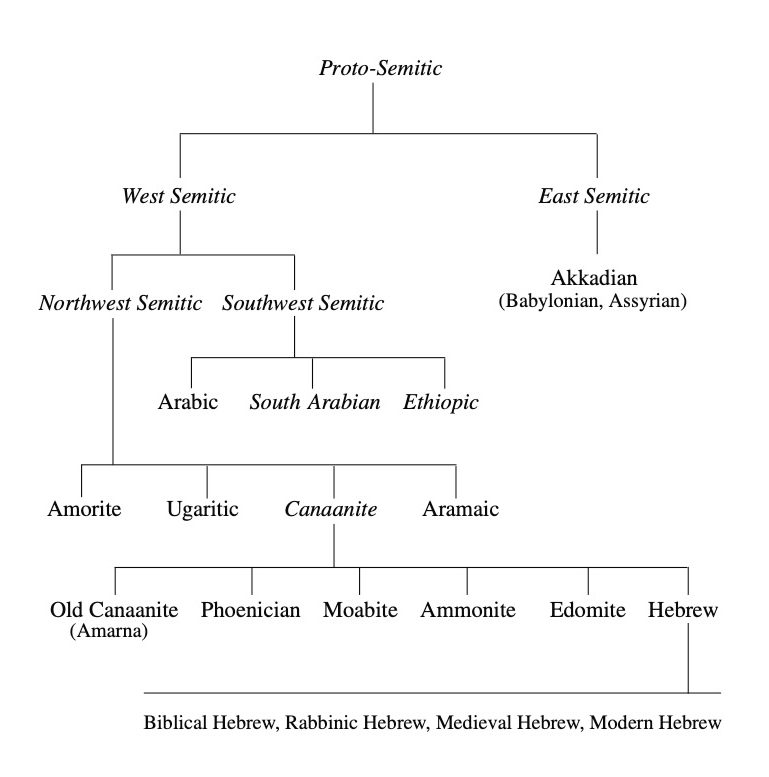
Previous scholars like (Albright 1959, Robertson 1972) dated the poem as early as the late second millennium. Archaic Hebrew predates Standard Classical Biblical Hebrew, and subsequent Late Biblical Hebrew, and it is found sporadically and unevenly throughout the Hebrew Bible. Texts like poetic songs from the blessing of Jacob in Genesis 49, the song of the sea and of Miriam in Exodus 15, song and prophecies in Numbers 23–24, and Deuteronomy 32, 33, Judges 5, and 2 Samuel 22 // Psalm 18, and other works like 1 Sam 2:1–10; 2 Sam 1:17–27; Habakkuk 3, and Job (Young, 2017). Psalm 68 would also be included by others such as (Gianto, 2016). Among some of the features scholars point out are unusual syntactical constructions, verbal forms or usages that differ from characteristic of Classical Biblical Hebrew, orthographic (spelling) features comparable to those found in First Temple-period inscriptions, and morphological patterns such as pronominal forms or suffixes that differ from the more familiar patterns of Biblical Hebrew. Such features have led scholars to identify certain biblical passages as potentially preserving linguistic characteristics that may reflect an earlier stage of the Hebrew language. Deuteronomy 32 is one of the passages that contain many of these features and will be used to illustrate some of them in the following study.
Opening Poetic Parallelism
הַאֲזִ֥ינוּ הַשָּׁמַ֖יִם וַאֲדַבֵּ֑רָה וְתִשְׁמַ֥ע הָאָ֖רֶץ אִמְרֵי־פִֽי׃ יַעֲרֹ֤ף כַּמָּטָר֙ לִקְחִ֔י תִּזַּ֥ל כַּטַּ֖ל אִמְרָתִ֑י כִּשְׂעִירִ֣ם עֲלֵי־דֶ֔שֶׁא וְכִרְבִיבִ֖ים עֲלֵי־עֵֽשֶׂב׃
“Give ear O heavens, that I may speak! Let the earth hear the sayings of my mouth. My teaching will drop like the rain, my words will flow like the dew; like soft rain upon the young grass, and as the showers upon the green plants.”
From the very beginning with the opening verses, this song already shows us an intersting syntactical pattern of poetic style parallelism. Verse, one states האזינו השמים ואדברה Give ear! O heaven that I may speak. The heavens are commanded with the verb האזינו in parallel with the verb, תשמע in the second line ותשמע הארץ אמרי פי Let the earth hear the words of my mouth. Similar phraseology is also used in other ancient poetic expressions such שמעו שמים והאזיני ארץ Give ear oh earth, listen oh heavens! from (Is 1:2). This type of poetic syntax reflects a highly developed poetic parallelism, while the cosmic scope of the address may preserve an older Northwest Semitic conception of the heavenly and earthly realms. The heavens, along with those in the heavens, are being commanded to give ear, and the earth and its inhabitants therein are also called upon to act as witnesses. Some have connected this address with the concept of a YHWH’s address to His divine council or בני האלהים (cf. Gen 6:2, Ps 89:7-9) which would fit naturally in a Late Bronze Age Early Iron Age backdrop in ancient Canaan. Furthermore, alternate sources such as the Greek Septuagint (LXX) translation, and the Dead Sea Scrolls (4QDeutj) give some insight to the potential cosmic and angelic language in this poem, especially in their alternate readings of verses such as Deut 32:8, 43. The following verses below are taken from (Pietersman & Wright NETS Primary Texts, 2007).
“8 When the Most High was apportioning nations, as he scattered Adam’s sons, he fixed boundaries of nations according to the number of divine sons.”
“43 Be glad, O skies, with him, and let all the divine sons do obeisance to him. Be glad, O nations, with his people, and let all the angels of God prevail for him. For he will avenge the blood of his sons and take revenge and repay the enemies with a sentence, and he will repay those who hate, and the Lord shall cleanse the land of his people.” (Deut 32:8, 43 NETS Translation)
While the small fragment of 4QDeutj offers very little data because it is so fragmented, there is a very clear end of line 14 of verse 9 which reads בני אלוהים instead of the MT בני ישראל. The reading of verse 43 is preserved much better and reveals a close resemblance to the LXX reading, although not identical. The following fragments below are taken from (Ulrich Biblical Scrolls from Qumran 2010). The translations are mine.
4QDeutj, col. XII
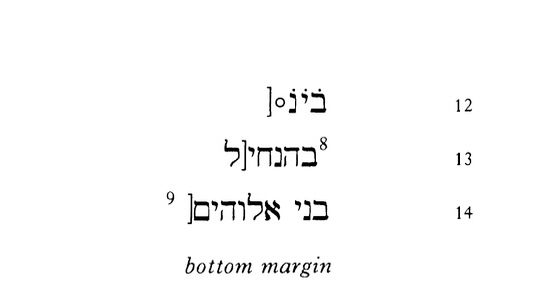
Fragment Translation
7 Consider…
8 When He divided…
The sons of God…
4QDeutq, col. II: frg. 5 ii
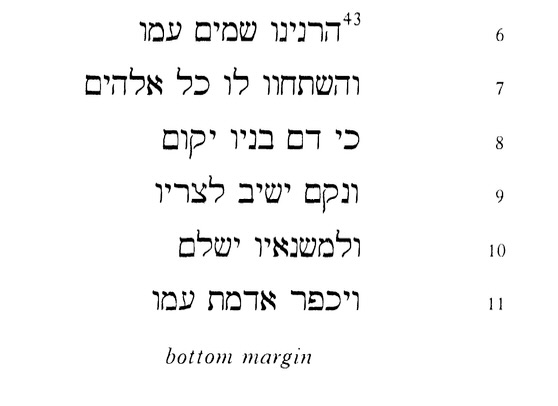
Fragment Translation
43 Rejoice O heavens His people
And bow down to Him all gods
For He will avenge the blood
of His sons, and render vengeance
to His enemies, and He will repay those who hate Him, and make atonement for the land of His people.
While these shouldn’t be read as more original versions or translations instead of the MT, because their Hebrew vorlage’s are chaotic and unknown in many cases–at the very least, the Qumran and Greek witnesses are particularly significant for reconstructing the textual and cosmological history of the Song. Lastly, to add to the poetic flavor of the text, the typical term דברי is replaced with אמרי the words of. Verse 2 continues the poetic buildup and intensifies the parallelism placing לקחי “my teaching” with אמרתי “my saying” in parallelism. Both terms are poetically marked and are rare outside wisdom or poetic literature. Next, the noun כשעירים שעיר) “like the soft rain” which is parallel to כרביבים (רבב)“showers” in the next line, which continually build this masterful poetic style while also illustrating rare vocabulary, a feature prevalent throughout the poem, but beyond the scope of this study.
(Deut 32:10-17) Unique use of Tenses and Morphology
These verses below are notable features within this poem. The use of the prefix conjugation, in Biblical Hebrew terms the imperfect/yiqtol. Typically, this conjugation is used to express future or present future actions and various modal senses (Gianto, 2016). Beginning with ימצאהו and continuing with יסבבנהו, יבוננהו, יצרנהו this creates a sequence of the Lord’s past actions of deliverance towards Israel. “He found him, He surrounded him, He instructed him, He preserved him.” In prose Classical Biblical Hebrew, a sequence of past mainline events would more typically be expressed through the sequential imperfect or wayyiqtol construction. Here, however, the poem employs prefix-conjugation forms with past temporal reference. This is a phenomenon unique to Archaic Biblical Hebrew where the yiqtol takes on a more ancient function. These verbal patterns as retentions of Old Canaanite features rooted in Northwest Semitic poetics. In this sphere the prefix conjugations yaqtul and yaqtulu were used in a larger variety to include the jussive, imperfective present future, past, and historical present (Notarius, 2013, Gianto, 2016).
The Northwest semitic imperfective yaqtulu became Hebrew yiqtol while keeping its present-future temporal reference and its various modal senses. At an earlier stage, including Archaic Biblical Hebrew, the yiqtol had a wider temporal range, and could also be used to refer to past sequential situations, the historical present or past durative. Some of these verbs also exhibit an ancient morphological feature referred to as the energic nun, a Northwest semitic verbal extension. As (Gianto, 2016) explains this was originally marked by נ in the third person prefix conjugation. (e.g., yaqtulan). This energic form survives in archaic biblical poetry, and there are several places in Archaic Biblical Hebrew where the הו of the third person masculine singular has not assimilated to the nun such as in our verses.
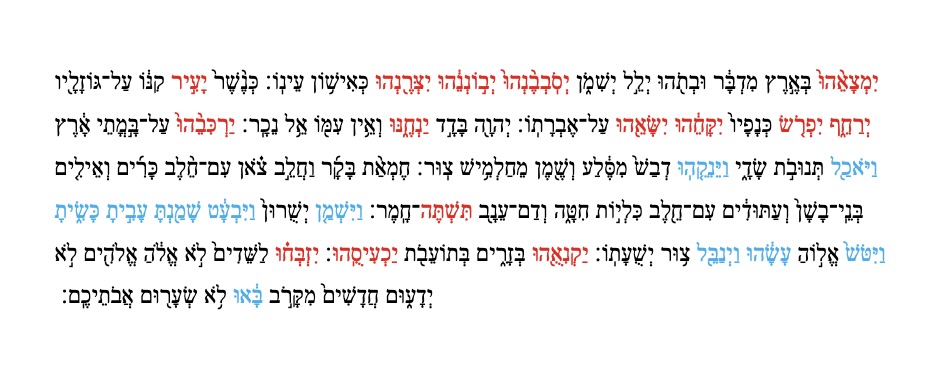
“He found him in a desert land, and in the howling wilderness waste; He surrounded him, He instructed him, He preserved him as the apple of his eye. As an Eagle stirs up its nest upon its young, flutters and spreads its wings, He took him and bore him up upon his pinions. The Lord alone guided him, and there was no other foreign god with him. He made him ride upon the high places of the earth, and he consumed the produce of the field, and He made him suck on honey from the rock, and oil from the flinty rock. And Jeshrun grew fat and kicked, you have grown fat, thick and sleek, then he forsook the God who made him and scorned the rock of his salvation. He provoked him to jealousy with strange gods, and with abomination he angered Him. He sacrificed to demons to gods they did not know, new gods who came lately whom your fathers did not dread.”
Conclusion: Unique Morphology
I will close this analysis with this notable morphological phenomonon which truly encapsulates the distinctiveness of Archaic Biblical Hebrew in our poem. The use of the 3mp suffix מו instead of the normal ם or הם. Accoring to (Gianto, 2016) the forms might refect the following development: first in Northwest Semitic it was *-hum, then it became *-himmā, and by analogy to the fem. pl. *-hinnā. From here the well attested Canaanite shift occurred and this was replaced by *-himmō; later, this form was shortened into -mō and written מו as in our verses here. The phenomenon is seen several times in our poem v23 עלימו upon them, v27 צרימו their adversaries, 32 ענבמו their grapes, 32 & 35 למו upon them/for them, 37 אלהימו their gods, 38 זבחימו their sacrafices. In sum, the linguistic features of Deuteronomy 32 including its rare archaic verbal forms, and preserved Northwest Semitic morphology, clearly situate the Song within the corpus of Archaic Biblical Hebrew. These elements not only reflect an early stage of the Hebrew language but also enhance the poem’s elevated style and theological gravity. As such, the Song offers a valuable glimpse into the poetic and linguistic traditions that shaped early Israelite literature.
Bibliography
Albright, W. F. “Some Remarks on the Song of Moses in Deuteronomy XXXII.” Vetus Testamentum 9, no. 1 (1959): 339–346
Blau, Joshua. Phonology and Morphology of Biblical Hebrew: An Introduction. Winona Lake, IN: Eisenbrauns, 2010.
Caplice, Richard. Introduction to Akkadian. 4th edition. Rome: Biblical Institute Press, 2002.
Huehnergard, John. An Introduction to Ugaritic. Peabody, MA: Hendrickson Publishers, 2012.
Gianto, Agustinus. “Archaic Biblical Hebrew.” In A Handbook of Biblical Hebrew, edited by W. Randall Garr and Steven E. Fassberg, Volume 1, 19–29. Winona Lake, IN: Eisenbrauns, 2016.
K. Elliger, W. Rudolph, and G. E. Weil, Biblia Hebraica Stuttgartensia, electronic ed. (Stuttgart: German Bible Society, 2003)
Henry Barclay Swete, The Old Testament in Greek: According to the Septuagint (Cambridge, UK: Cambridge University Press, 1909), Dt 32:8.
Notarius, Tania. “Lexical Isoglosses of Archaic Hebrew: פְּלִילִים (Deut 32:31) and כֵּן (Judg 5:15) as Case Studies.” Hebrew Studies 58 (2017): 81–98
Notarius, Tania. The Verb in Archaic Biblical Poetry: A Discursive, Typological, and Historical Investigation of the Tense System. Supplements to Vetus Testamentum 163. Leiden: Brill, 2013.
Robertson, David A. Linguistic Evidence in Dating Early Hebrew Poetry. SBL Dissertation Series 3. Missoula, MT: Society of Biblical Literature, 1972.
Steven Fassburg and Avi Hurvitz, Biblical Hebrew in Its Northwest Semitic Setting Typological and Historical Perspectives, 2006, The Hebrew University Magness Press Jerusalem and Eisenbrauns Winona Lake Indiana.
Ulrich, Eugene. The Biblical Qumran Scrolls. Supplements to Vetus Testamentum 134. Leiden: Brill, 2010, 240.
W. Randall Garr and Steven Fassberg, 2016, A Handbook of Biblical Hebrew Volume 1: Periods, Corpora, and Reading Traditions, Eisenbrauns, Winona Lake, Indiana.
Young, Ian. “Starting at the Beginning with Archaic Biblical Hebrew.” Hebrew Studies 58 (2017): 99–118. https://doi.org/10.1353/hbr.2017.0005
 Ancient Bible World
Leave a comment